Monday, December 2, 2019

First African Country to Adopt EIOS

Nigeria's public health institute, known as NCDC (Nigeria Centre for Disease Control), has just been approved by the World Health Organization as the first country in Africa to adopt the EIOS (Epidemic Intelligence from Open Sources) tool. This is a great step forward and a call for celebration for all Nigerians as such technology will assist in the advancement of Nigeria's disease risk and prevention.


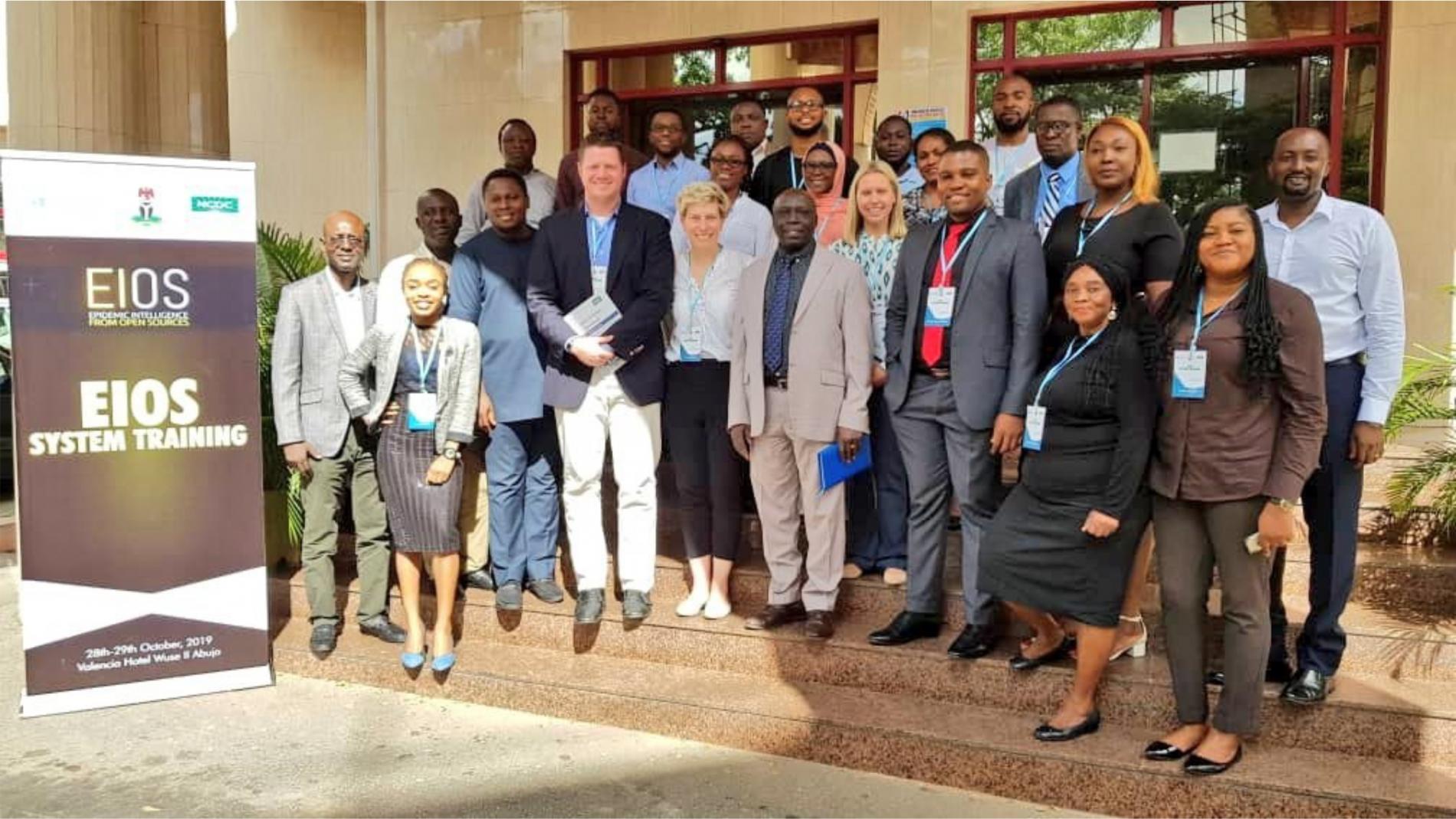
Pictured above is a group of mostly NCDC employees as they attended a three-day workshop organized by the World Health Organization which helped train them on how to use the EIOS tool.

Already existing within the NCDC are two types of early detection surveillance tools, indicator-based surveillance and event-based surveillance. The newly incorporated EIOS platforms will help support NCDC's event-based surveillance functions. The EIOS initiative has a goal to "create a unified, all-hazards, One Health approach by using open source information for early detection, verification and assessment of public health risks and threats". It is our hope that these new EIOS tools will provide the Nigeria Centre for Disease Control with increased functionality, preventing illness and saving lives with early detection for rapid response.

Bibliography:

“WHO Supports Nigeria to Become First African Country to Adopt New Epidemic Intelligence Tool.” World Health Organization, World Health Organization, 8 Nov. 2019, https://www.afro.who.int/news/who-supports-nigeria-become-first-african-country-adopt-new-epidemic-intelligence-tool.


Hate Speech: Punishable by Death?


Nigeria's government has been ramping up as of recent with even more controversial legislature! Along with the social media bill which was previously posted on, Nigeria's Senate is preparing legislation which makes hate speech punishable by death. The bill is called "The Prohibition of Hate Speech Bill", and includes an extensive repository of possible wrongdoings one could commit. Based on the bill, hate speech can be defined in a variety of different ways, whether it be through the "publication or presentation of material deemed to stir up ethnic hatred" or from "written or visual acts seen as threatening, abusive, insulting, or offensive". 

Like the social media bill, the hate speech bill has also been met with much debate from the Nigerian public. The bill definitely comes with a very real possibility of intense punishment. The proposed states that a person who has committed an offense can be jailed for life, but if their actions are "found to have caused loss of life, the punishment can be death by hanging". To address concerns from the public about the severity of punishment, Senator Abdullahi, sponsorer of the bill, has indicated that the death sentence stipulation of the bill could be removed. Still, Abdullahi insists that stricter laws must be implemented as hate speech has become an increasing problem for Nigerians.

Bibliography:

Abdulrauf, Abdulrahman. “Nigeria Bill Aims at Punishing Hate Speech with Death: DW: 26.11.2019.” DW.COM, 26 Nov. 2019, https://www.dw.com/en/nigeria-bill-aims-at-punishing-hate-speech-with-death/a-51419750.

Nigeria Launches Sex Offenders Register


According to UNICEF, one in four Nigerian women are sexually abused before they turn 18. Most of these cases are not prosecuted. This is a statistic that is as disheartening as it is morbid, though recent developments in Nigeria have an aim to tackle violence against women. Specifically, for the first time ever, Nigeria has launched its national sexual offenders register. This register has been seen as an important step towards "clamping down on abuse" as it exposes the database of those who have been convicted of sexual violence crimes.

Nigeria's Minister for Humanitarian Affairs stated that a "humanitarian and security crisis in northeast Nigeria caused by a decade-long armed campaign had seen a rise in cases of sexual abuse which needed to be addressed", and the register will serve as a strategy to help halt and deter future violence. The register can be accessed by all ordinary citizens, and it is available online.

Bibliography:

“Nigeria Launches First National Sex Offenders Register.” News | Al Jazeera, Al Jazeera, 26 Nov. 2019, https://www.aljazeera.com/news/2019/11/nigeria-launches-national-sex-offenders-register-191126063421032.html.

Lighting up Nigeria

Nigeria is Africa's most populous country. It resides 200 million people, though only 60% of these people have electricity access. Last week, the Nigerian government announced that this percentage was set to increase, as it awarded a share of a $75 million World Bank-funded grant to a company named Lumos Global BV. This move goes in accordance with Nigeria's efforts to "back quick and simple solutions to the country's energy deficit due to an absent or unreliable electricity grid".


Lumos Global BV is a Dutch company which specializes in off-grid solar power. In association with the Nigerian government, Lumos plans to light up over one million Nigerian homes with solar by 2025. The company has already installed over 100,000 solar home systems around Nigeria, and with each installation they will be subsidized with a fee.

Since the 1980's, Nigeria has operated with a dilapidated power network, which deprives use of their total power capacity. As of current, solar would be the quickest way to provide power to all households.

Bibliography:

Clowes, William. “Dutch Company to Light a Million Nigerian Homes With Solar.” Bloomberg.com, Bloomberg, 30 Nov. 2019, https://www.bloomberg.com/news/articles/2019-12-01/dutch-company-to-light-a-million-nigerian-homes-with-solar-power.

Nigeria to Get University of Transportation

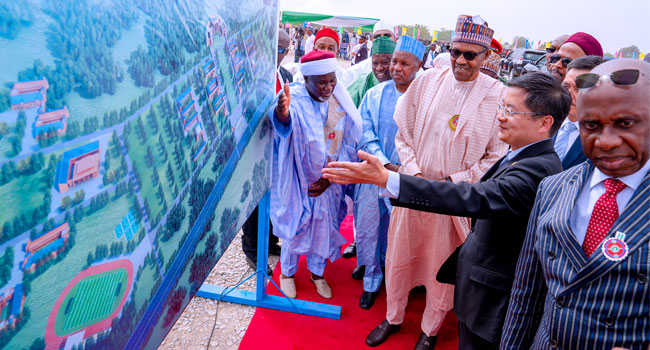
Exciting news comes after a groundbreaking ceremony in Daura: Nigeria is set to establish a University of Transportation in Daura, Katsina State. President Muhammadu Buhari was in attendance, and the new university will be built at the site of his hometown. The government will facilitate all necessary supportive functions to ensure the establishment of the University. During the ceremony, the president talked of his administration's "commitment to prioritizing the participation of indigenes and application of local content to the development of infrastructure".


Nigeria's Minister for Transportation, Mr. Rotimi Amaechi, also had some input to add, exclaiming that the move to build the university was fueled by a need for Nigerian talent to maintain the infrastructures built in the country. Maintenance and management of Nigeria's infrastructure is key as it is vast and ever-growing, and increasing education will help provide a method for the madness.

Bibliography:

“Nigeria Set To Get University Of Transportation.” Channels Television, Channels Inc Limited, 31 Dec. 1969, https://www.channelstv.com/2019/12/02/nigeria-set-to-have-university-of-transportation/.

“Why the University of Transport Is Sited in Daura.” P.M. News, 2 Dec. 2019, https://www.pmnewsnigeria.com/2019/12/02/why-the-university-of-transport-is-sited-in-daura/.

Nigeria's Fintech Unicorn

Nigeria's booming fintech industry has led some to believe that it could be crowned Africa's unofficial "capital for fintech investment and digital finance startups". In November alone, over $360 million had been invested in Nigerian payment ventures. Interestingly to note, over half of this came directly from Chinese investors. Even more interesting is the fact that this amount is equivalent to one-third of all startup venture capital raised for the continent of Africa in 2018!


The article then goes on to elaborate on several of Nigeria's top performing fintech companies. The unicorn known as "Interswitch" stood out to me the most; in finance, a unicorn is a startup company valued at over $1 billion. Interswitch first made its name when it "pioneered the infrastructure to digitize Nigeria's then predominantly paper-ledger and cash-based economy". Since its incorporation, the company now provides much of the tech-wiring for Nigeria's online banking system. With the services it provides, it is no wonder this fintech company soared through the ranks so quickly. With Nigerian talent continuing to make advancements in infrastructure and technology, their future is boundless.

Bibliography:

Bright, Jake. “Africa Roundup: Nigerian Fintech Gets $360M, Mints Unicorn, Draws Chinese VC.” TechCrunch, TechCrunch, 2 Dec. 2019, https://techcrunch.com/2019/12/01/africa-roundup-nigerian-fintech-gets-360m-mints-unicorn-draws-chinese-vc/.

Controversial Social Media Bill

Recently proposed in Nigeria's parliament is a controversial piece of legislation: the social media bill. Last week, the social media bill advanced through the Nigerian Senate. The bill stipulates that police has the authority to "arrest people whose posts are thought to threaten national security, sway elections, or diminish public confidence in the government". Those who violate the regulation incur the risk of having their Internet access cut off. Although the bill certainly has an aim to protect citizens from "fake news", many Nigerians are opposed to its incorporation. In fact, an online petition to stop the bill has already amassed over 70,000 signatures.


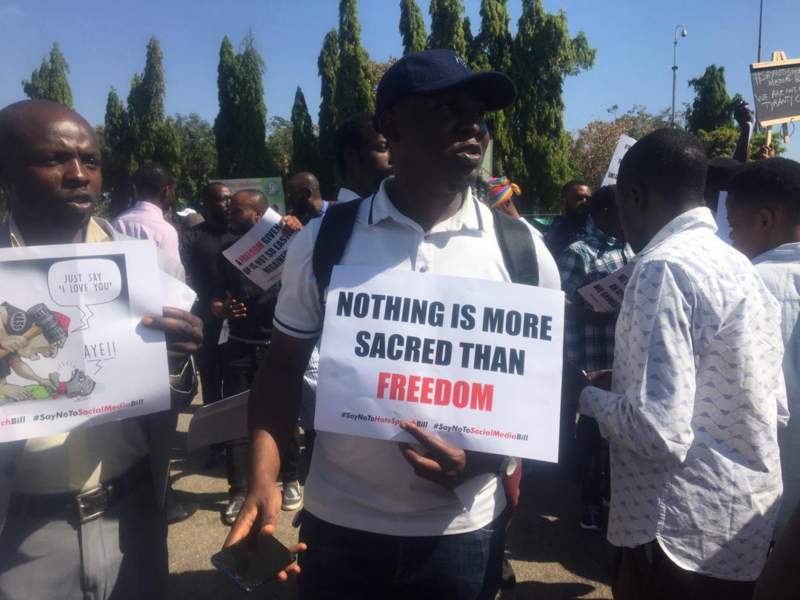
Pictured above is a recent demonstration by Nigerian activists who are protesting the bill. Many Nigerians worry that the bill intends to suppress one's freedom of speech and expression. They worry that giving law enforcement agencies the right to shut down internet at any time is too much power. Supporters of the bill argue that the bill is not an attempt to stifle free speech- instead, "it is an opportunity to address growing threats in [Nigeria] that could disrupt peaceful coexistence". Nigeria already has regulations prohibiting libel and slander, so the social media bill would essentially add another layer of censors into law. 

Bibliography:

Paquette, Danielle. “Nigeria's 'Fake News' Bill Could Jail People for Lying on Social Media. Critics Call It Censorship.” The Washington Post, WP Company, 25 Nov. 2019, https://www.washingtonpost.com/world/africa/nigerias-fake-news-bill-could-jail-people-for-lying-on-social-media-critics-call-it-censorship/2019/11/25/ccf33c54-0f81-11ea-a533-90a7becf7713_story.html.

Confronting the Colonial Archive

Between the years of 1909 and 1915, British colonial anthropologist Northcote Thomas accumulated thousands of documents and photographs, many depicting Nigerian men, women, and children. While reading this news article, I found that I could not help but relate its subject to our in-class studies on colonialism and its effects on African people. The images shared by anthropologist Northcote Thomas are extremely thought provoking, they paint a vivid picture of an age of prejudice in which African people were treated as second-rate citizens.


The attached images depict two young Nigerian men; these images really struck a chord with me. Thomas often gave his "subjects" a number-id which would serve to identify the individual. These assigned numbers are reminiscent of the system established for Jews during the Holocaust and effectively served to "further dehumanize" African people. Thomas also took special interest in photographing scarification marks, facial characteristics, and hair styles. Many of these photos are meant to be "physical-type" portraits, an abhorrent practice intended to identify and classify people into different tribal categories. The photos taken by Thomas and shared within this archive are greatly reflective of the racially-fueled, “reprehensible colonial mindset”. 


Biliography:

“Confronting the Colonial Archive – in Pictures.” The Guardian, Guardian News and Media, 19 Nov. 2019, https://www.theguardian.com/artanddesign/gallery/2019/nov/19/the-anthropologists-africa-in-pictures-faces-voices.

First African Country to Adopt EIOS

Nigeria's public health institute, known as NCDC (Nigeria Centre for Disease Control), has just been approved by the World Health Organi...